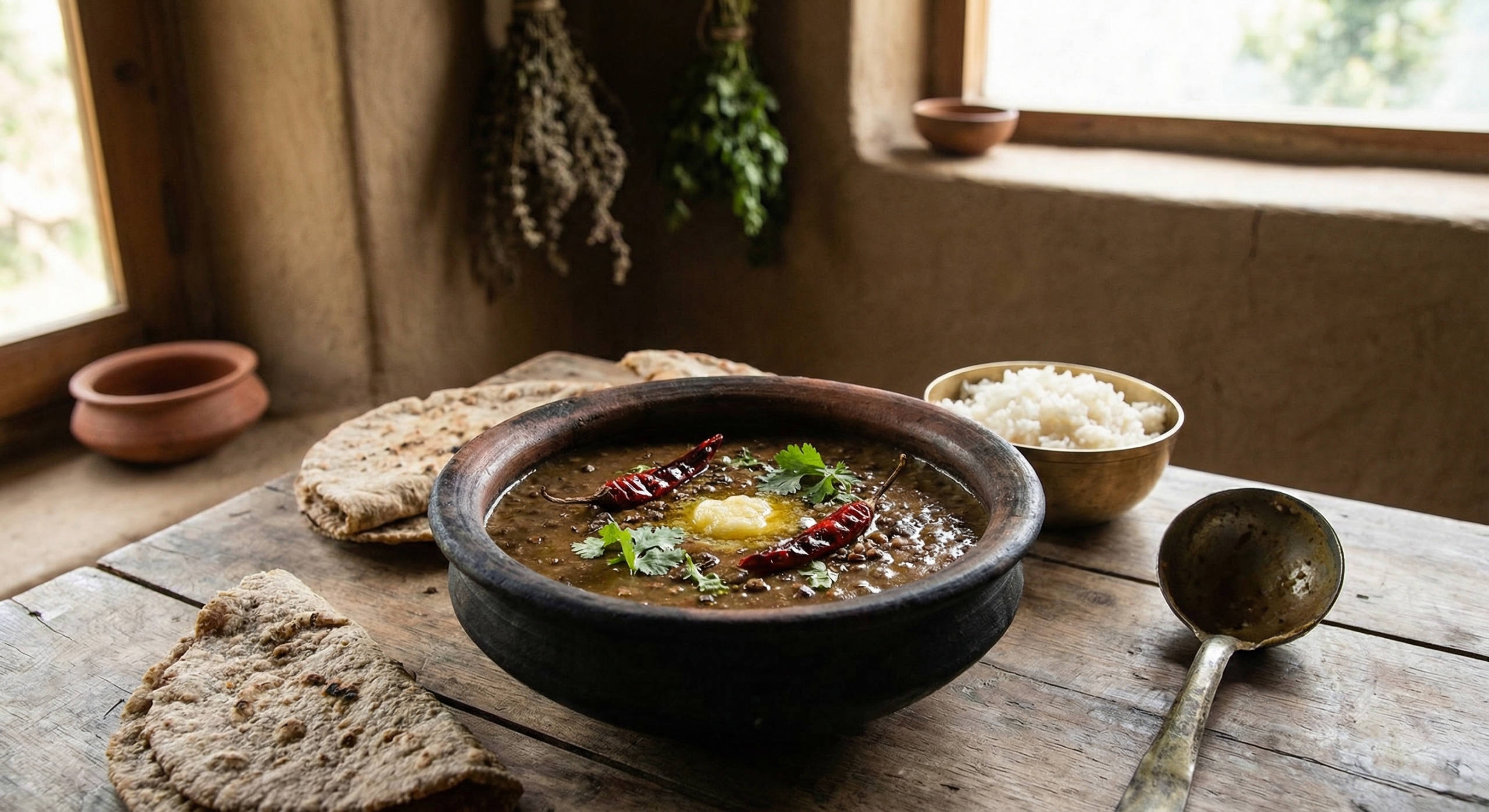
Namaste, foodie bestie! 🏔️ Today, we are climbing high into the snow-capped peaks of Uttarakhand to discover a dish that is as rugged and soulful as the Himalayas themselves. Welcome to the world of Garhwali Chainsoo. If you’ve only ever had your dal boiled and tempered with cumin, get ready for a mind-blowing experience. Chainsoo is made by roasting black gram (urad dal) until it’s nutty and fragrant, then grinding it into a coarse flour. It’s thick, it’s earthy, and it’s the ultimate mountain comfort food. Let’s get roasting!
The Story of Chainsoo: A Pahari Ritual of Fire and Stone
To truly appreciate Chainsoo, you have to imagine life in a traditional Pahari (mountain) village. Historically, winters in the Garhwal and Kumaon regions are long and brutal. The people needed food that was high in protein, easy to store, and warming for the body. Black gram (Urad dal) was the perfect candidate. But the Paharis didn’t just boil it; they developed a unique technique of dry-roasting the dal on a heavy iron tawa before grinding it. This roasting process doesn’t just add flavor; it makes the dal easier to digest—crucial when you’re living at high altitudes!
Historically, Chainsoo was cooked over a slow wood-fire (chulha) in a traditional iron pot called a Karao. The iron from the pot would react with the roasted dal, giving the dish its signature deep, dark color and a boost of natural iron. Every household had its own secret spice blend, but the one non-negotiable ingredient was Jakhiya (wild Himalayan mustard). These tiny, crunchy black seeds are found only in the mountains and give the dish a unique, pungent pop that you just can’t replicate with regular mustard seeds.
But Chainsoo is more than just a winter survival meal. It’s a dish of community and memory. In the old days, after the harvest, families would gather around the fire, and the sound of the dal being ground in a stone mill (sil-batta) would echo through the village. It’s a dish that celebrates the simplicity of mountain life—where a few handfuls of dal, a bit of ginger, and some mountain water can be transformed into a feast. It represents the “Pahari” spirit: resilient, warming, and deeply connected to the earth.
Today, as many young people move from the villages to cities like Dehradun or Delhi, Chainsoo has become a powerful symbol of “home.” It’s the dish that mothers pack for their sons, and the one that is craved most during the rainy season. When you eat a bowl of Chainsoo with a mound of steaming red rice (Lal Chawal), you’re not just eating a meal; you’re tasting the history of a people who have thrived in one of the most beautiful but challenging landscapes on Earth. It’s a liquid hug from the Himalayas.
The Authentic Garhwali Chainsoo Recipe
This is the traditional method. Roasting the dal is the most important step—don’t rush it!
- Prep time: 15 mins
- Cook time: 35 mins
- Serves: 3-4 hungry mountain explorers
Ingredients:
- 1 cup Whole Black Gram (Sabut Urad Dal)
- 1 tsp Jakhiya seeds (substitute with mustard seeds if unavailable)
- 1/2 tsp Cumin seeds
- 4-5 cloves of Garlic, smashed
- 1 inch Ginger, finely minced
- 2-3 dried Red Chilies
- 1/2 tsp Turmeric, 1 tsp Coriander powder
- 2 tbsp Mustard oil (essential for the Pahari flavor!)
- Salt to taste
- 3-4 cups hot water
Instructions:
- The Roast: Heat a heavy pan (iron is best). Dry roast the whole black gram on medium heat for 8-10 minutes until it turns aromatic and slightly changes color. Do not burn it!
- The Grind: Let the dal cool, then grind it in a mixer to a coarse powder. We don’t want fine flour; it should have a bit of texture.
- The Sauté: Heat mustard oil in an iron kadhai until it smokes. Add Jakhiya (or mustard seeds), cumin, and dried red chilies.
- The Aromatics: Add the smashed garlic and ginger. Sauté for a minute until golden.
- The Dal Flour: Add the ground dal powder to the oil and sauté for another 2-3 minutes. Add turmeric and coriander powder.
- The Simmer: Slowly add the hot water while stirring continuously to avoid lumps. Bring to a boil, then lower the heat.
- The Slow Cook: Cover and let it simmer for 20-25 minutes. The dal will thicken and turn dark. The longer it cooks, the better it tastes!
- Serve: Serve hot with Red Rice or Mandua (Ragi) Rotis.
FAQs: Your Himalayan Kitchen Guide!
1. Why is it important to roast the dal first?
Roasting gives the dal a nutty, smoky flavor and significantly reduces the “slimy” texture that black gram can sometimes have. It also makes the dal much more aromatic.
2. Can I use split urad dal instead of whole?
Yes, you can, but the whole black gram (with the skin on) provides a much richer, deeper flavor and that signature dark color.
3. What if I can’t find Jakhiya?
Jakhiya has a very specific nutty flavor and crunch, but you can use regular black mustard seeds as a substitute. The dish will still be delicious!
4. Is Chainsoo supposed to be thick?
Yes! It should have a consistency similar to a thick gravy or a heavy soup. It’s meant to be hearty enough to be a stand-alone meal with rice.
5. Can I add vegetables to it?
Traditionally, Chainsoo is kept simple to highlight the flavor of the dal. However, some people add small pieces of radish or pumpkin for extra texture.
Bring the soul of Uttarakhand to your table today! Let me know if you can feel the mountain breeze after the first spoonful! 🏔️🥣✨
Leave a Reply