
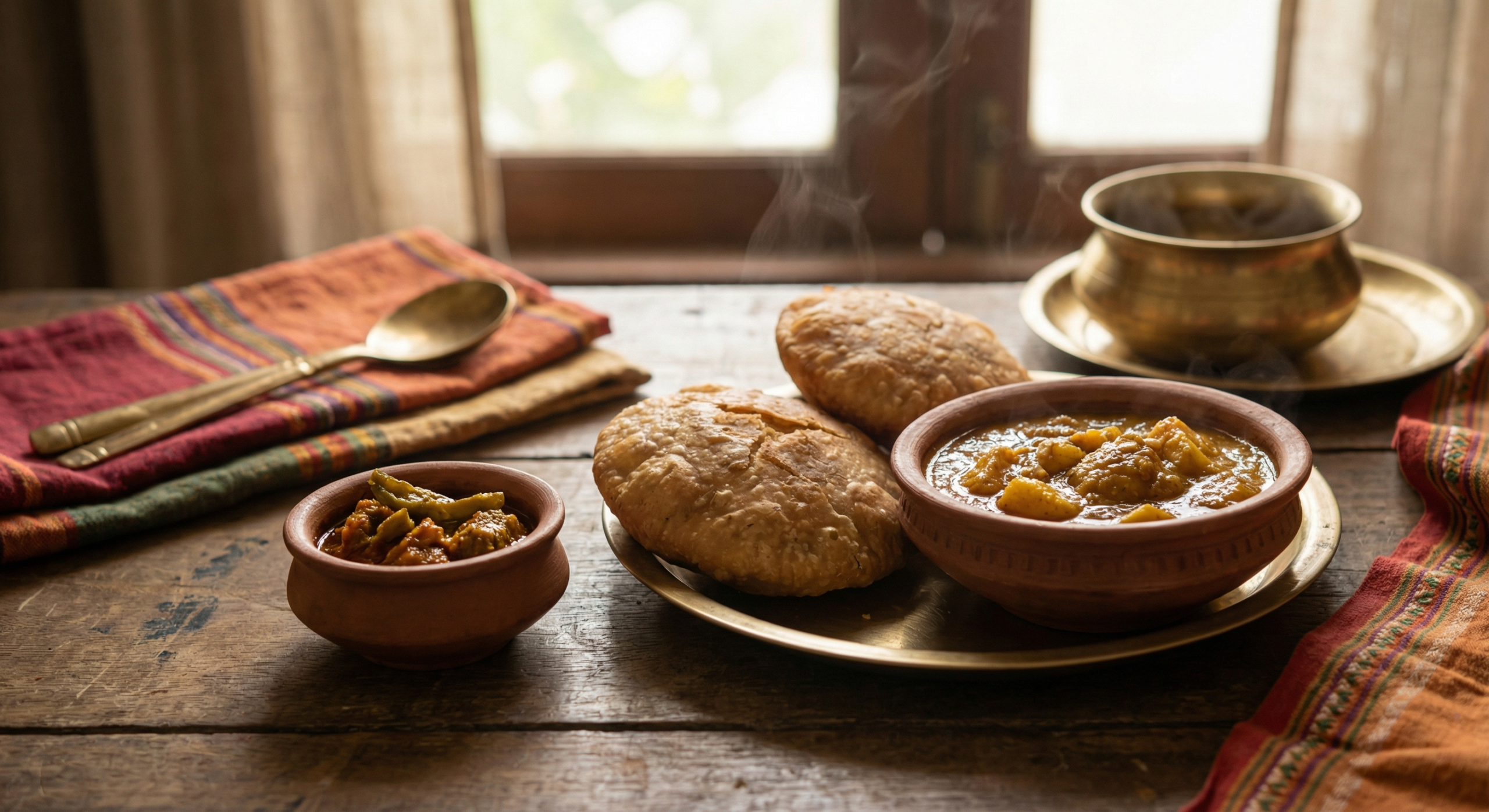
Namaste, foodie bestie! 🥟 If you’ve ever walked through the narrow, bustling lanes of Mathura, Agra, or Old Delhi at 8 AM, you know the smell. It’s the intoxicating aroma of deep-frying dough, pungent hing (asafoetida), and spicy simmering potatoes. We are talking about the legend itself: UP Bedmi Kachori. This isn’t just a breakfast; it’s a morning ritual that has fueled millions of souls for centuries. Forget your cereal and toast—once you’ve had a hot, puffed-up Bedmi with a side of Dubki Wale Aloo, there’s no going back. Let’s get crunchy!
The Story of Bedmi: A Thousand-Year Crunch
The history of the Kachori is as deep and layered as the pastry itself. Believe it or not, variations of stuffed, deep-fried lentil breads have been mentioned in Indian texts dating back over one thousand years! While Rajasthan is often credited with the invention of the Kachori, it was the Braj region of Uttar Pradesh (the land of Krishna) that perfected the “Bedmi” style. Historically, the Marwari community played a huge role in spreading this snack across North India as they traveled for trade, but it was the local halwais (sweet makers) of UP who turned it into a breakfast staple.
So, what makes a Bedmi different from a regular Kachori? Traditionally, a Kachori is a small, hard, stuffed snack that can last for days. A Bedmi, however, is more like a hybrid between a Puri and a Kachori. It’s made with a coarse wheat flour (moat) mixed with ground urad dal and a heavy dose of spices. Historically, this was the “power breakfast” for laborers and farmers. The protein from the dal and the energy from the wheat provided enough fuel to last through a grueling day of work in the fields or the market.
But there’s a spiritual side to Bedmi too! In the temple towns of Mathura and Vrindavan, Bedmi is often served as part of the morning prasad or “Bhog” for the deities. The street food culture here is legendary. You’ll see shops that have been using the same sourdough-like starter or specific spice blends for four or five generations. The “Dubki Wale Aloo” that traditionally accompanies Bedmi is a thin, watery potato curry that is so spicy and tangy it makes your eyes water—and that’s exactly how it’s supposed to be! The thin curry perfectly balances the thick, heavy crust of the Bedmi.
Eating Bedmi is an art form. You stand on the sidewalk, holding a leaf bowl (dona), while the halwai scoops out a steaming hot ladle of aloo curry and crushes a fresh-out-of-the-oil Bedmi right on top. It’s hot, it’s messy, and it’s pure North Indian soul food. Whether you’re a tourist exploring the Taj Mahal or a local grabbing a quick bite before work, the Bedmi Kachori is the great equalizer—everyone stands in the same line for that perfect, spicy crunch. When you bite into a Bedmi, you’re not just eating a snack; you’re tasting a millennium of North Indian culinary history.
The Authentic UP Bedmi Kachori Recipe
This recipe gives you the secret to that perfectly coarse, crispy texture and the iconic spicy potato curry.
- Prep time: 30 mins (plus soaking)
- Cook time: 30 mins
- Serves: 4 hungry breakfast lovers
Ingredients:
- For the Bedmi Dough:
- 1 cup Urad Dal (split black gram), soaked for 4 hours
- 2 cups Whole Wheat Flour (Atta)
- 1/2 cup Semolina (Sooji) for extra crunch
- 1 tsp Fennel seeds (Saunf), crushed
- 1/2 tsp Ginger paste
- 1/4 tsp Asafoetida (Hing)
- 1 tsp Red chili powder
- 2 tbsp Oil (for moyan/shortening)
- Salt to taste
- Oil for deep frying
- For the Aloo Curry:
- 4 large potatoes, boiled and roughly mashed by hand
- 2 large tomatoes, pureed
- 1 tsp Cumin seeds
- 1/2 tsp Hing
- 1 tsp Turmeric, 1 tbsp Coriander powder, 1 tsp Amchur (dry mango powder)
- Fresh coriander for garnish
Instructions:
- The Dal Paste: Grind the soaked urad dal with as little water as possible into a coarse paste. Add the ginger, hing, fennel, and chili powder to this paste.
- The Dough: In a large bowl, mix the wheat flour, sooji, salt, and 2 tbsp oil. Add the dal paste and knead into a very stiff dough. Let it rest for 20 minutes.
- The Curry: While the dough rests, heat oil in a pan. Add cumin and hing. Add the tomato puree and all the dry spices. Sauté until oil separates.
- Simmer: Add the mashed potatoes and 3 cups of water. Let it simmer on low heat for 15-20 minutes until it becomes a slightly thick, flavorful gravy. Add amchur at the end.
- The Rolling: Roll out small, slightly thick discs (like thick puris) from the dough.
- The Fry: Heat oil in a kadhai on medium-high. Fry the Bedmis until they puff up and turn a deep golden brown on both sides.
- Serve: Serve hot Bedmis with a big ladle of the potato curry and a side of green chili pickle!
FAQs: Master the Bedmi!
1. Why is my Bedmi soft and not crispy?
Two reasons: either your dough was too soft (you added too much water) or the oil wasn’t hot enough. The dough must be very stiff to get that signature crunch!
2. Can I use Moong Dal instead of Urad Dal?
You can, but it’ll be a different dish! Urad dal gives that specific sticky, earthy flavor and “chew” that is the hallmark of an authentic UP Bedmi.
3. What are “Dubki Wale Aloo”?
It literally means “drowning potatoes.” It’s a thin, spicy curry where the potatoes are just roughly broken so they “drown” in the gravy. No onions or garlic are used in the traditional version!
4. Is Bedmi Kachori vegan?
Yes, it is! It uses only plant-based ingredients. If you fry them in oil rather than ghee (which most street vendors do to save costs), they are 100% vegan.
5. Can I store the dough?
You can refrigerate the dough for up to 24 hours. In fact, some say the flavors of the dal and spices meld even better after a few hours of resting!
There you have it—a classic North Indian breakfast that’ll keep you full until dinner! Give it a go and tell me: how many could you eat? 🥟🔥✨
Leave a Reply